


Containment
- Open a Windows profile, then click the 'Containment' tab.
'Containment' runs programs the client does not recognise inside a container, so that they cannot change the real system. The panel carries 'Save' and 'Delete' buttons and has six sub-tabs.
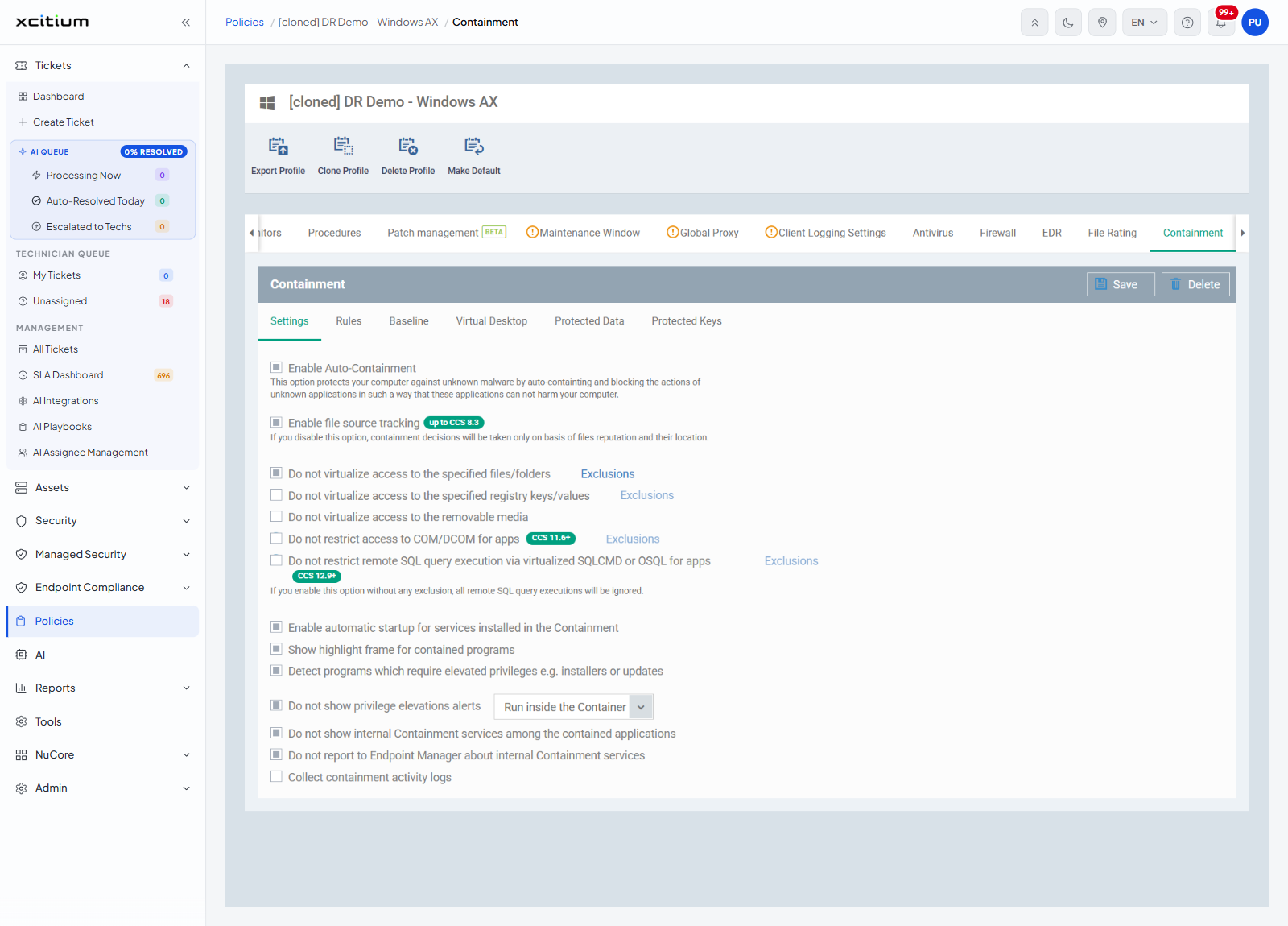
Settings
| Setting | Badge | Description |
| Enable Auto-Containment | — | 'This option protects your computer against unknown malware by auto-containting and blocking the actions of unknown applications in such a way that these applications can not harm your computer.' |
| Enable file source tracking | up to CCS 8.3 | 'If you disable this option, containment decisions will be taken only on basis of files reputation and their location.' |
| Do not virtualize access to the specified files/folders | — | Has its own 'Exclusions' link. |
| Do not virtualize access to the specified registry keys/values | — | Has its own 'Exclusions' link. |
| Do not virtualize access to the removable media | — | — |
| Do not restrict access to COM/DCOM for apps | CCS 11.6+ | Has its own 'Exclusions' link. |
| Do not restrict remote SQL query execution via virtualized SQLCMD or OSQL for apps | CCS 12.9+ | Has its own 'Exclusions' link. The note underneath reads 'If you enable this option without any exclusion, all remote SQL query executions will be ignored.' |
| Enable automatic startup for services installed in the Containment | — | — |
| Show highlight frame for contained programs | — | Draws a border round a contained program's window so the device user can see it. |
| Detect programs which require elevated privileges e.g. installers or updates | — | — |
| Do not show privilege elevations alerts | — | A drop-down underneath sets what happens instead: 'Run inside the Container' (the default), 'Run Unlimited', 'Run Unlimited and Trust' or 'Block'. |
| Do not show internal Containment services among the contained applications | — | — |
| Do not report to Endpoint Manager about internal Containment services | — | — |
| Collect containment activity logs | — | — |
Add an exclusion to a setting
Four of the settings above carry their own 'Exclusions' link: 'Do not virtualize access to the specified files/folders', 'Do not virtualize access to the specified registry keys/values', 'Do not restrict access to COM/DCOM for apps' and 'Do not restrict remote SQL query execution via virtualized SQLCMD or OSQL for apps'. Each link opens the same 'Manage Exclusions' dialog, which keeps a separate list for the setting it was opened from.
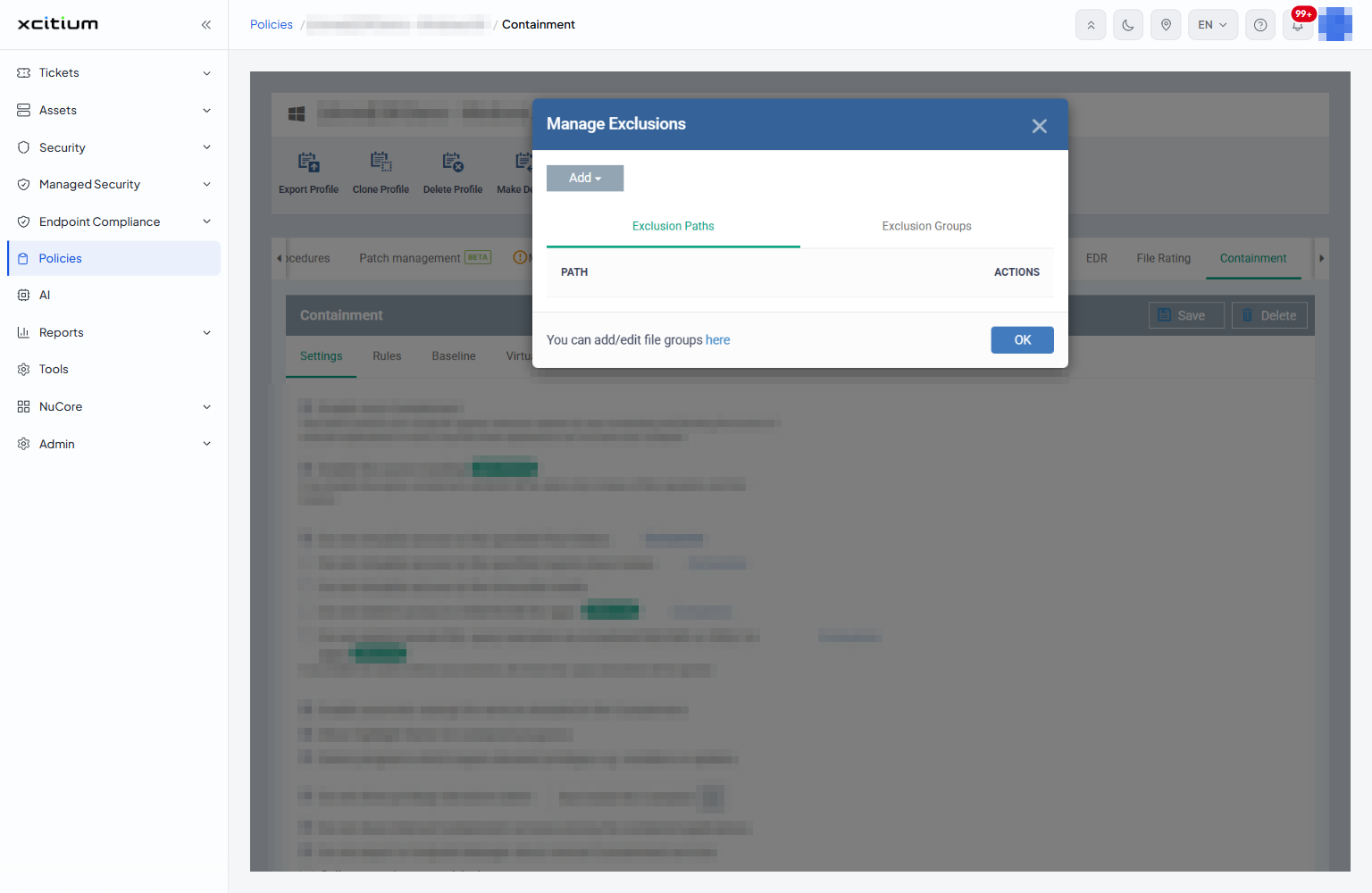
| Control | Description |
| Exclusion Paths | A tab listing individual paths, under the columns 'PATH' and 'ACTIONS'. |
| Exclusion Groups | A tab listing whole file groups, under the columns 'Groups' and 'Actions'. The line beside it reads 'You can add/edit file groups here'. |
| Add | A drop-down with two entries. 'Path' adds a single path; 'File Groups' opens a list of the file groups you can add. |
- Click 'Policies' in the left navigation bar and open the profile.
- Click the 'Containment' tab and stay on 'Settings'.
- Click the 'Exclusions' link beside the setting you want to narrow.
- Click 'Add' and choose 'Path' or 'File Groups'.
- Click 'OK', then click 'Save'.
Rules
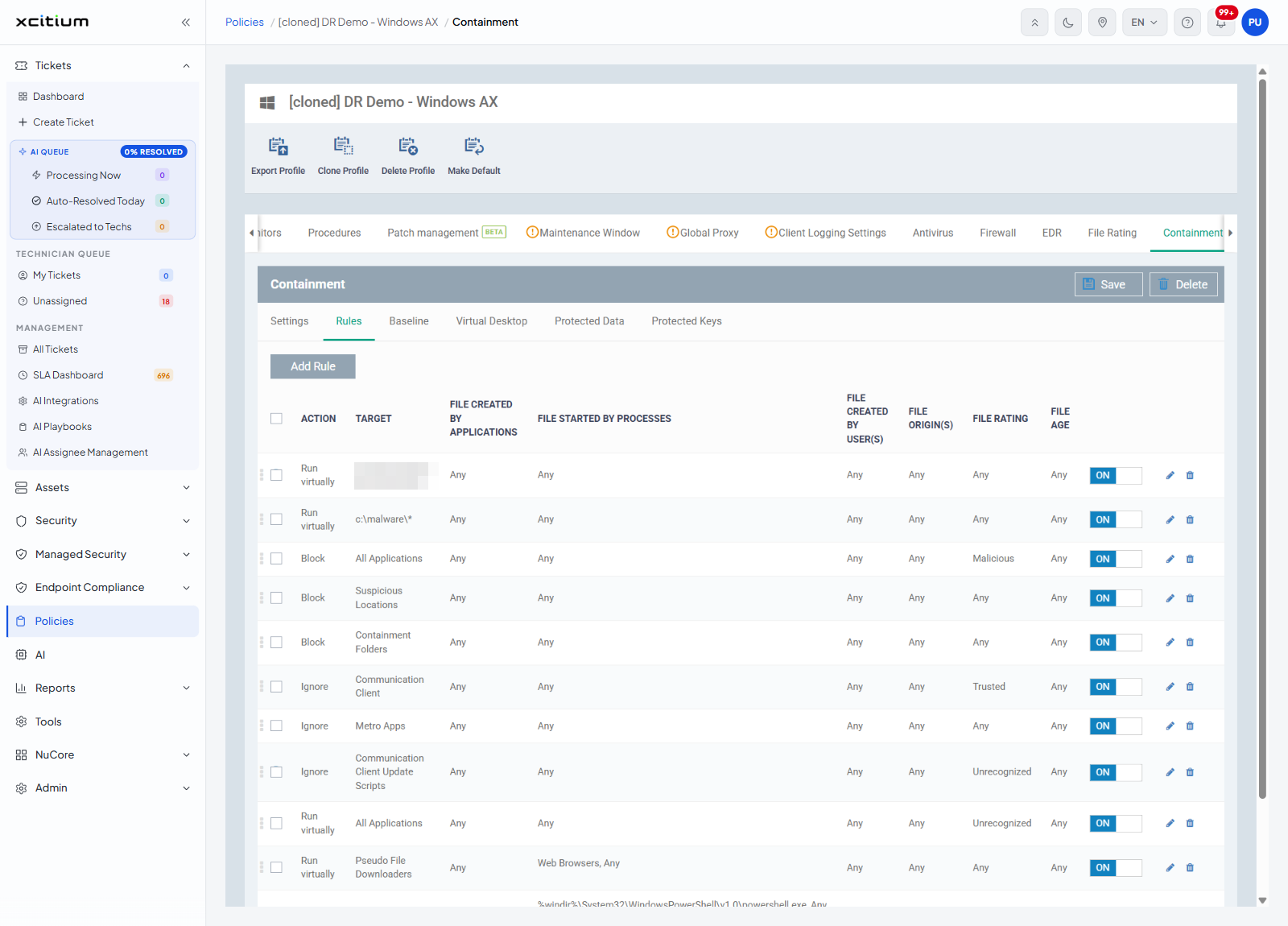
The rules that decide what is contained, with an 'Add Rule' button above the list. Rules are read from the top down.
| Column | Description |
| Check box (first column) | Ticks the rule. |
| ACTION | What the rule does. The values seen were 'Run virtually', 'Block' and 'Ignore'. |
| TARGET | What the rule applies to — a folder, a file pattern, or a named group such as 'All Applications', 'Suspicious Locations', 'Containment Folders', 'Metro Apps', 'Pseudo File Downloaders' or 'Global Whitelist'. |
| FILE CREATED BY APPLICATIONS | Narrows the rule to files written by named applications. 'Any' when it is not narrowed. |
| FILE STARTED BY PROCESSES | Narrows the rule to files started by named processes, for example web browsers or the PowerShell executables. 'Any' when it is not narrowed. |
| FILE CREATED BY USER(S) | Narrows the rule to files written by named users. 'Any' when it is not narrowed. |
| FILE ORIGIN(S) | Narrows the rule to files from a named origin. 'Any' when it is not narrowed. |
| FILE RATING | Narrows the rule by the file's rating. The values seen were 'Any', 'Malicious', 'Trusted' and 'Unrecognized'. |
| FILE AGE | Narrows the rule by how old the file is. 'Any' when it is not narrowed. |
| (last column) | An ON/OFF toggle that turns the rule on or off. |
Add a containment rule
'Add Rule' opens the 'Manage Contained Program' dialog. The line under 'Action' reads 'The selected containment action will be applied if file properties match the following criteria:'.
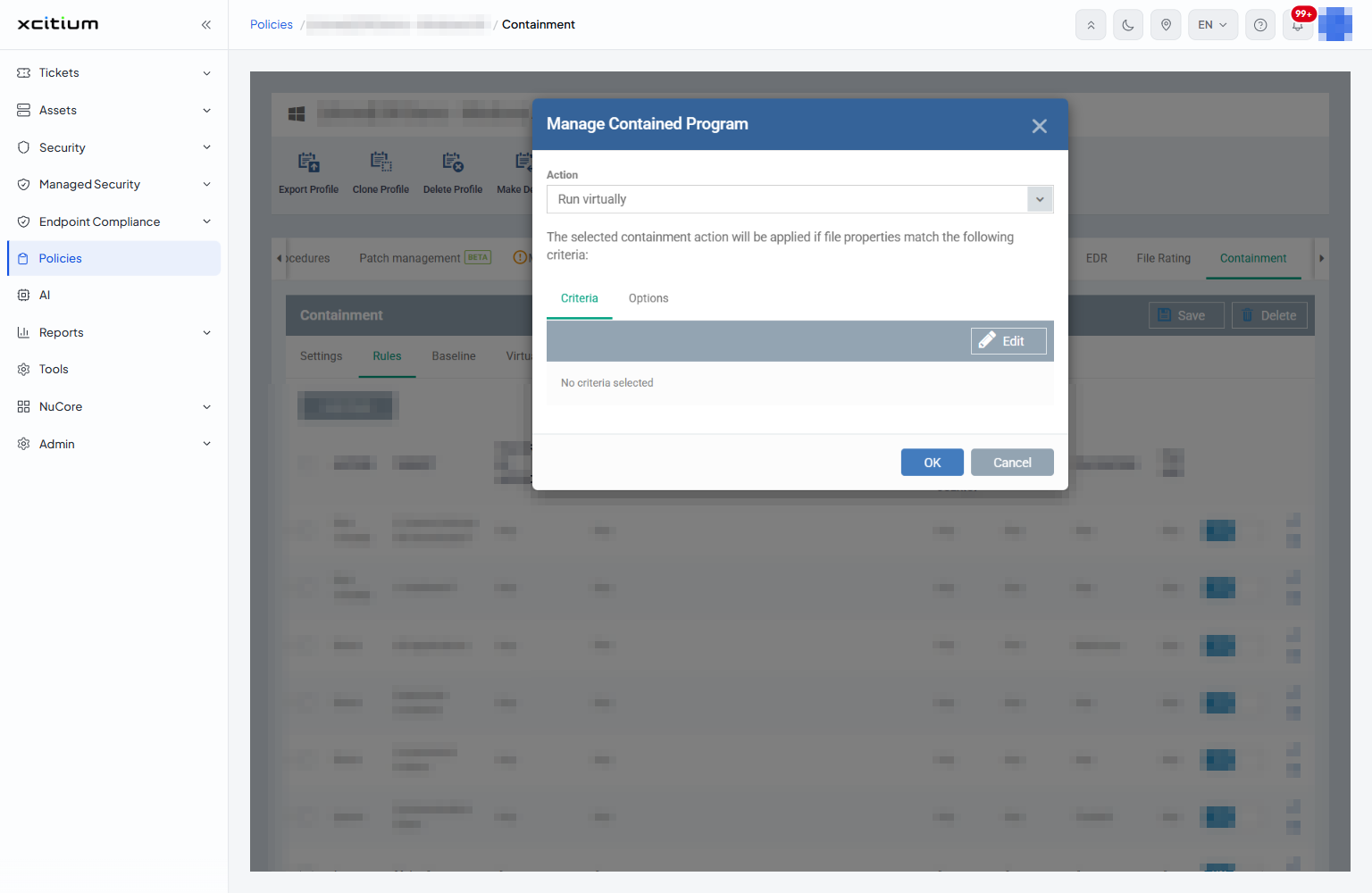
| Field | Description |
| Action | What the rule does to a matching program: 'Run restricted', 'Run virtually', 'Block' or 'Ignore'. |
| Criteria | A tab holding what the rule matches. It shows 'No criteria selected' until you click 'Edit'. |
| Options | A tab holding the settings below. |
| Log when this action is performed | Records an event each time the rule fires. |
| Do NOT apply the selected action to child processes | Limits the rule to the program itself. |
| Quarantine program | Moves the program to quarantine as well as applying the action. |
| Set restriction level | Sets how much the program may do: 'Untrusted', 'Restricted', 'Limited' or 'Partially Limited'. |
| Limit maximum memory consumption to (MB) | Caps the memory the program may use. |
| Limit program execution time to (sec) | Caps how long the program may run. |
| Prohibit usage of SMB shared resources | Keeps the program off network shares. |
| Don't allow access to other processes memory | Keeps the program out of the memory of other programs. |
Choose what a containment rule matches
'Edit' on the 'Criteria' tab opens the 'File Criteria' dialog, headed 'Please select the criteria to be applied'.
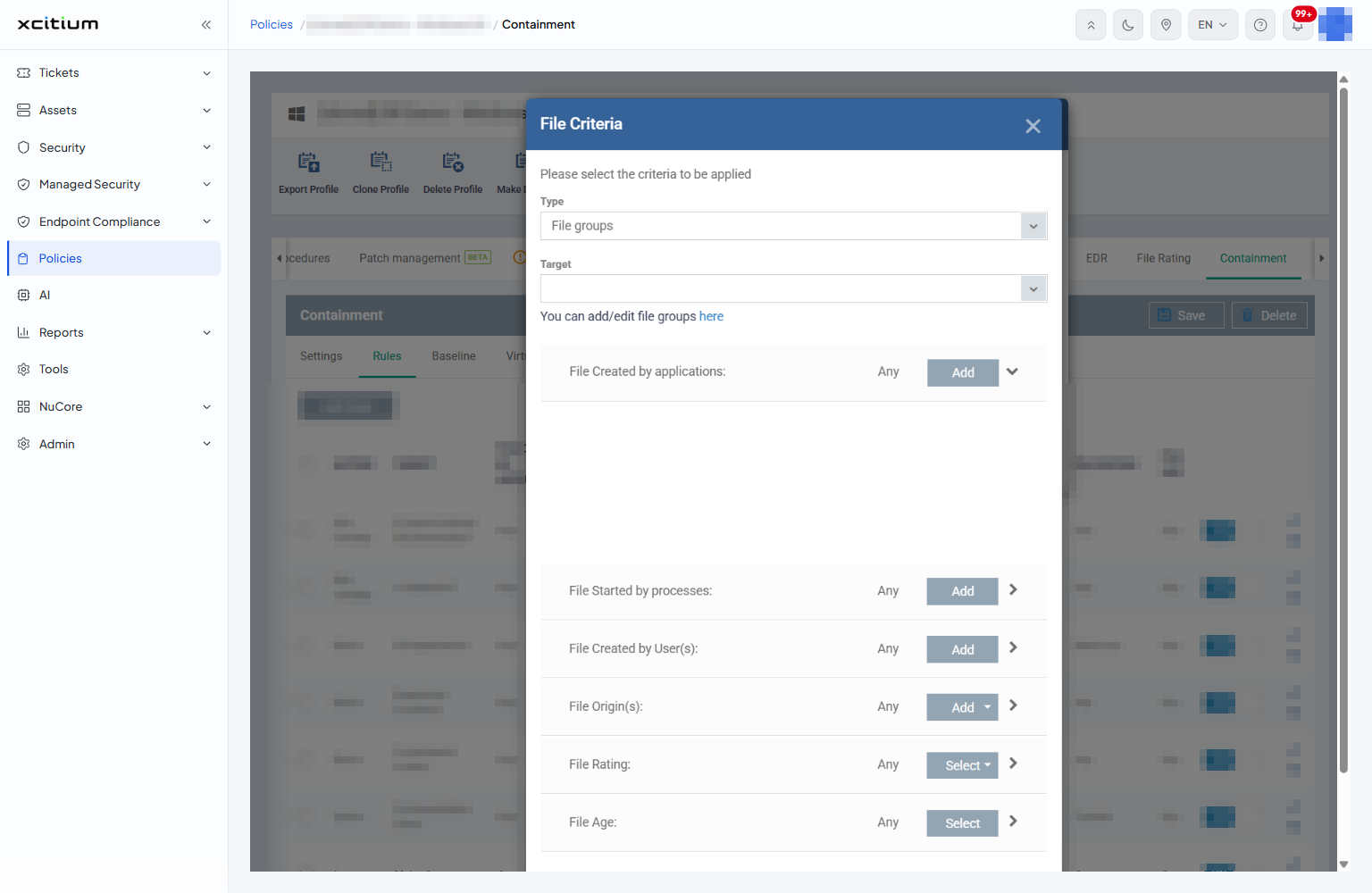
| Field | Description |
| Type | What the rule is matched against: 'Files', 'File groups', 'Folder', 'File hash' or 'Process hash'. |
| Target | The thing of that type the rule covers. The list changes with 'Type'. |
| File Created by applications: | Narrows the rule to files written by named applications. 'Add' picks them. Leave it as 'Any' not to narrow. |
| File Started by processes: | Narrows the rule to files started by named processes. |
| File Created by User(s): | Narrows the rule to files written by named users. |
| File Origin(s): | Narrows the rule by where the file came from: 'Internet', 'Removable Media' or 'Intranet'. |
| File Rating: | Narrows the rule by rating: 'Trusted', 'Unrecognized' or 'Malicious'. |
| File Age: | Narrows the rule by how old the file is. |
- Click 'Policies' in the left navigation bar and open the profile.
- Click the 'Containment' tab, then click 'Rules'.
- Click 'Add Rule' and choose the 'Action'.
- On 'Criteria', click 'Edit', choose a 'Type' and pick the 'Target'. Narrow it further with the rows underneath if you need to.
- Click 'OK' to close 'File Criteria'.
- Click 'Options' and set the logging and restriction options.
- Click 'OK', then click 'Save'.
Note: a new rule goes to the bottom of the list. Move it up if it must be read before an existing rule.
Baseline
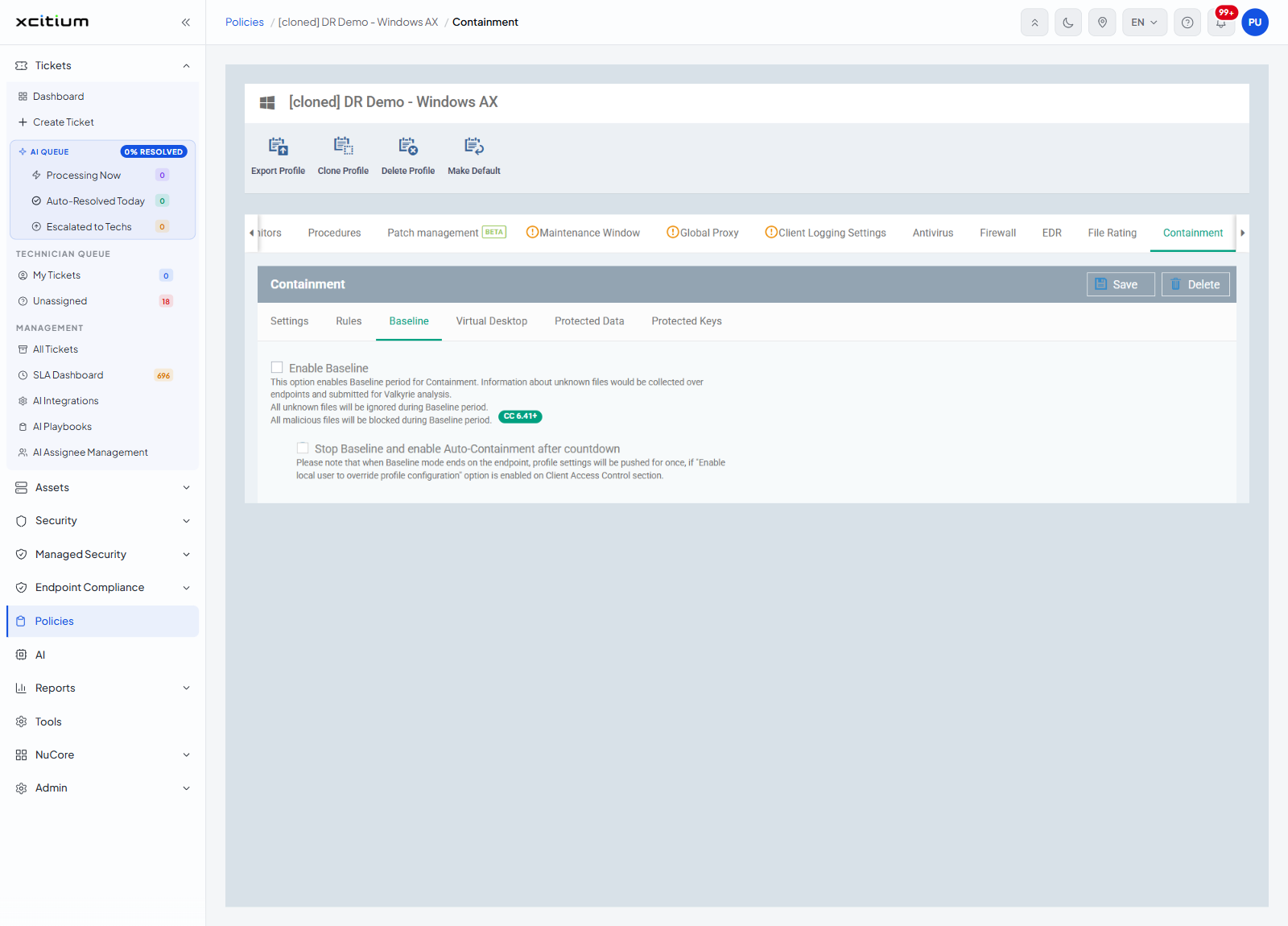
| Setting | Badge | Description |
| Enable Baseline | — | 'This option enables Baseline period for Containment. Information about unknown files would be collected over endpoints and submitted for Valkyrie analysis.' |
| All unknown files will be ignored during Baseline period. | — | — |
| All malicious files will be blocked during Baseline period. | CC 6.41+ | — |
| Stop Baseline and enable Auto-Containment after countdown | — | Ends the baseline period automatically and switches containment on. |
The note at the foot of the sub-tab reads: 'Please note that when Baseline mode ends on the endpoint, profile settings will be pushed for once, if "Enable local user to override profile configuration" option is enabled on Client Access Control section.'
Virtual Desktop
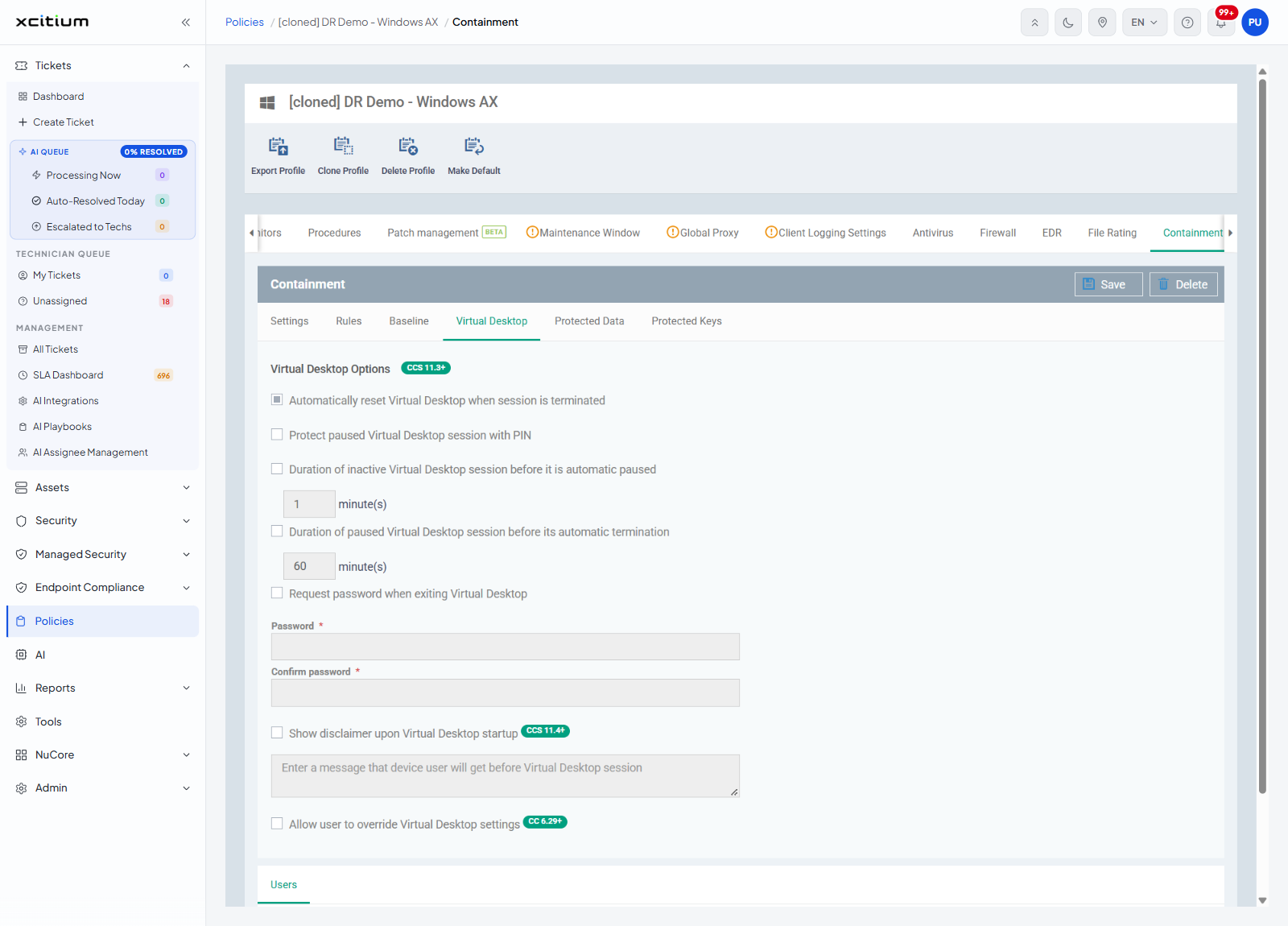
The group is headed 'Virtual Desktop Options' and carries the badge 'CCS 11.3+'.
| Setting | Badge | Description |
| Automatically reset Virtual Desktop when session is terminated | — | — |
| Protect paused Virtual Desktop session with PIN | — | — |
| Duration of inactive Virtual Desktop session before it is automatic paused | — | A number box, in minutes. |
| Duration of paused Virtual Desktop session before its automatic termination | — | A number box, in minutes. |
| Request password when exiting Virtual Desktop | — | Reveals 'Password' and 'Confirm password', both marked with a red asterisk. |
| Show disclaimer upon Virtual Desktop startup | CCS 11.4+ | — |
| Allow user to override Virtual Desktop settings | CC 6.29+ | — |
A 'Users' list at the foot of the sub-tab, with 'Add' and 'Delete' buttons and the columns 'USER/GROUPS' and 'ON/OFF', carries the line 'Add user groups to launch Virtual Desktop upon login'.
Add a user group to the Virtual Desktop
'Add' under the 'Users' list opens the 'Add Creator By' dialog.
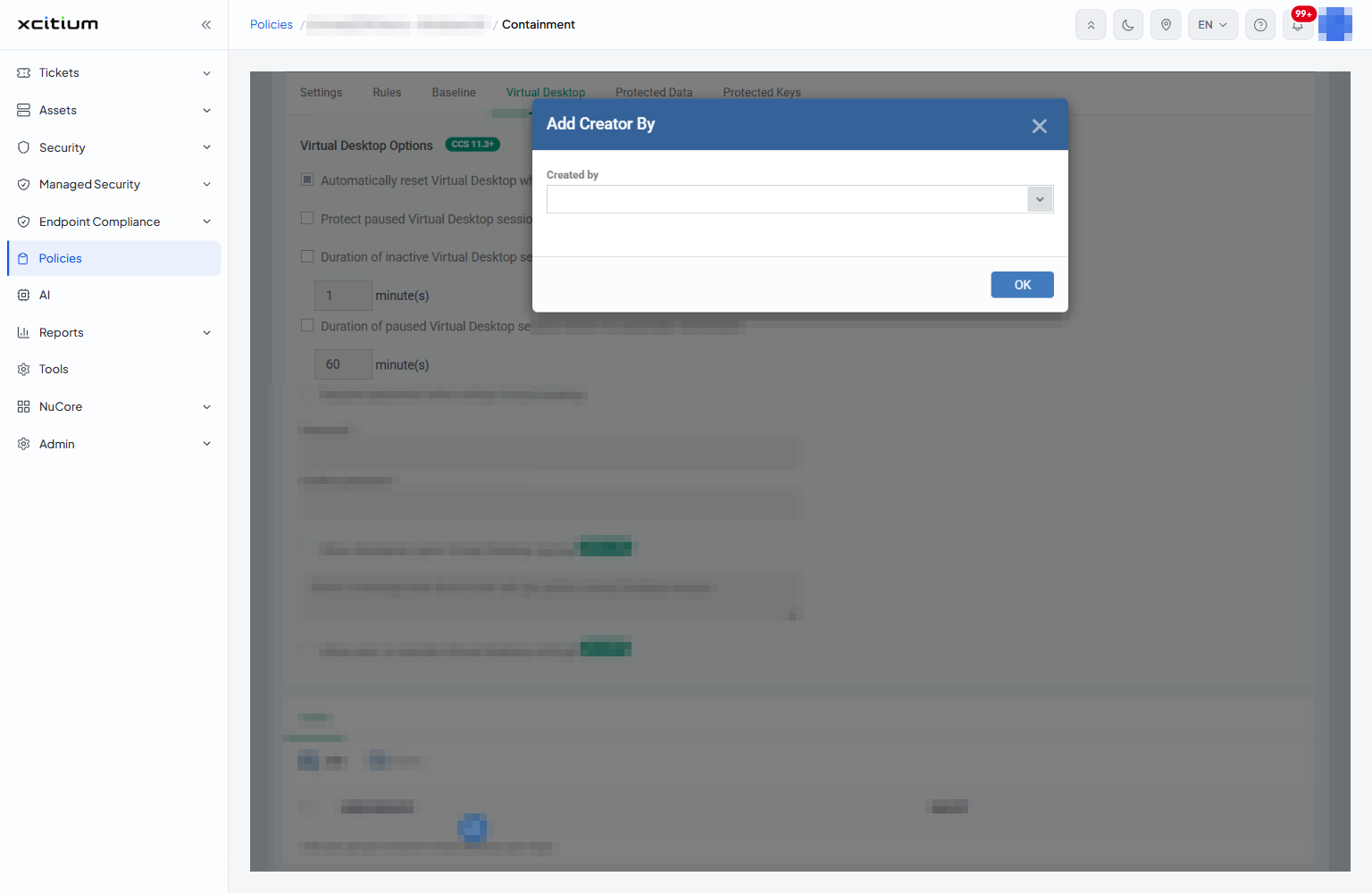
| Field | Description |
| Created by | The user or group that may launch the Virtual Desktop: 'Everyone', 'Local', 'Network', 'Anonymous', 'Authenticated users', 'Administrators', 'Users', 'Guests' or 'Power user'. |
- Click 'Policies' in the left navigation bar and open the profile.
- Click the 'Containment' tab, then click 'Virtual Desktop'.
- Scroll to the 'Users' list and click 'Add'.
- Choose a group under 'Created by'.
- Click 'OK', then click 'Save'.
Protected Data
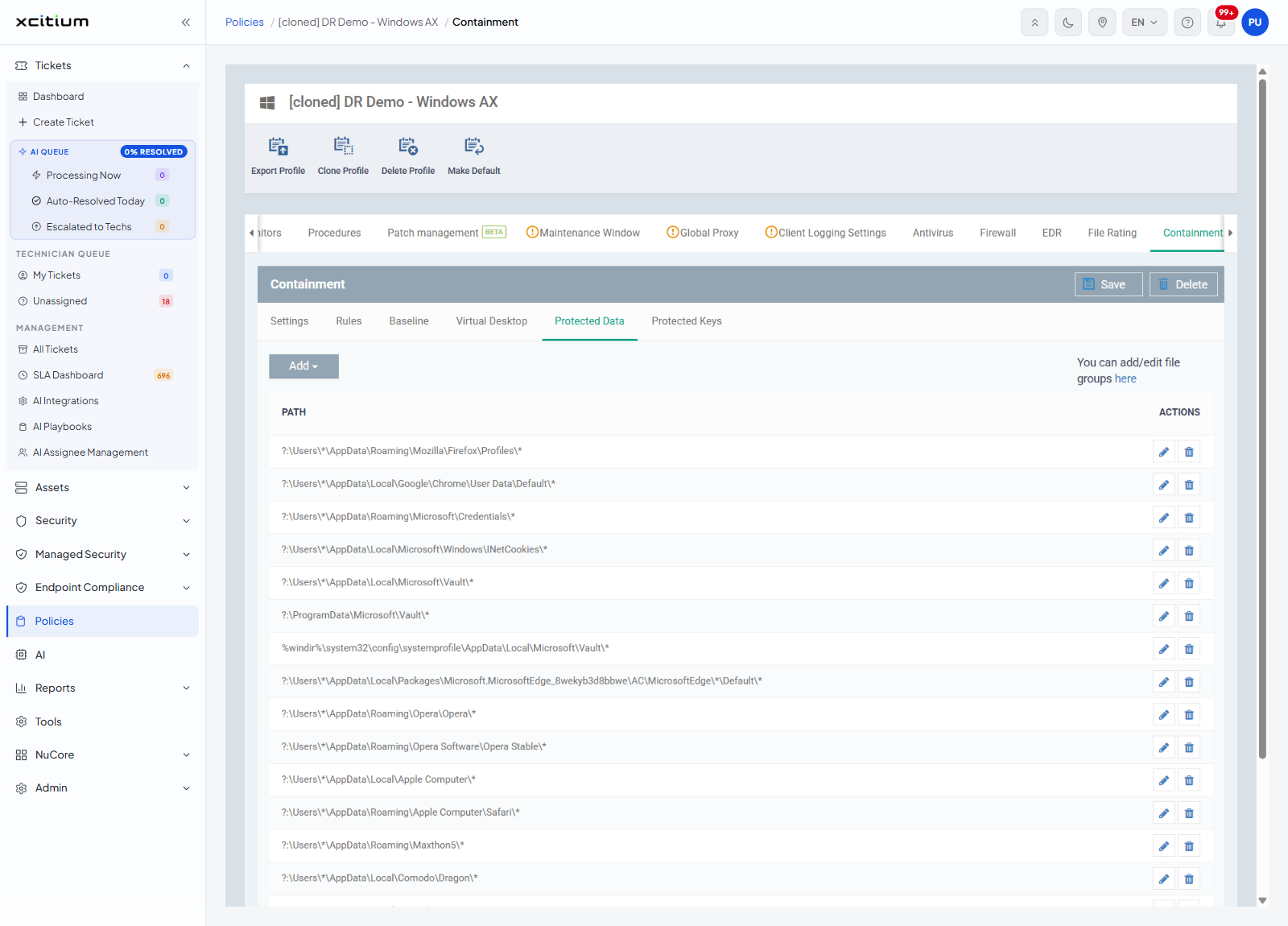
Folders that contained programs must not read. The 'Add' button sits above the list, with the line 'You can add/edit file groups here'. The list has two columns, 'PATH' and 'ACTIONS'. The list can include entries such as browser profile folders, credential stores and mail client folders.
Protected Keys
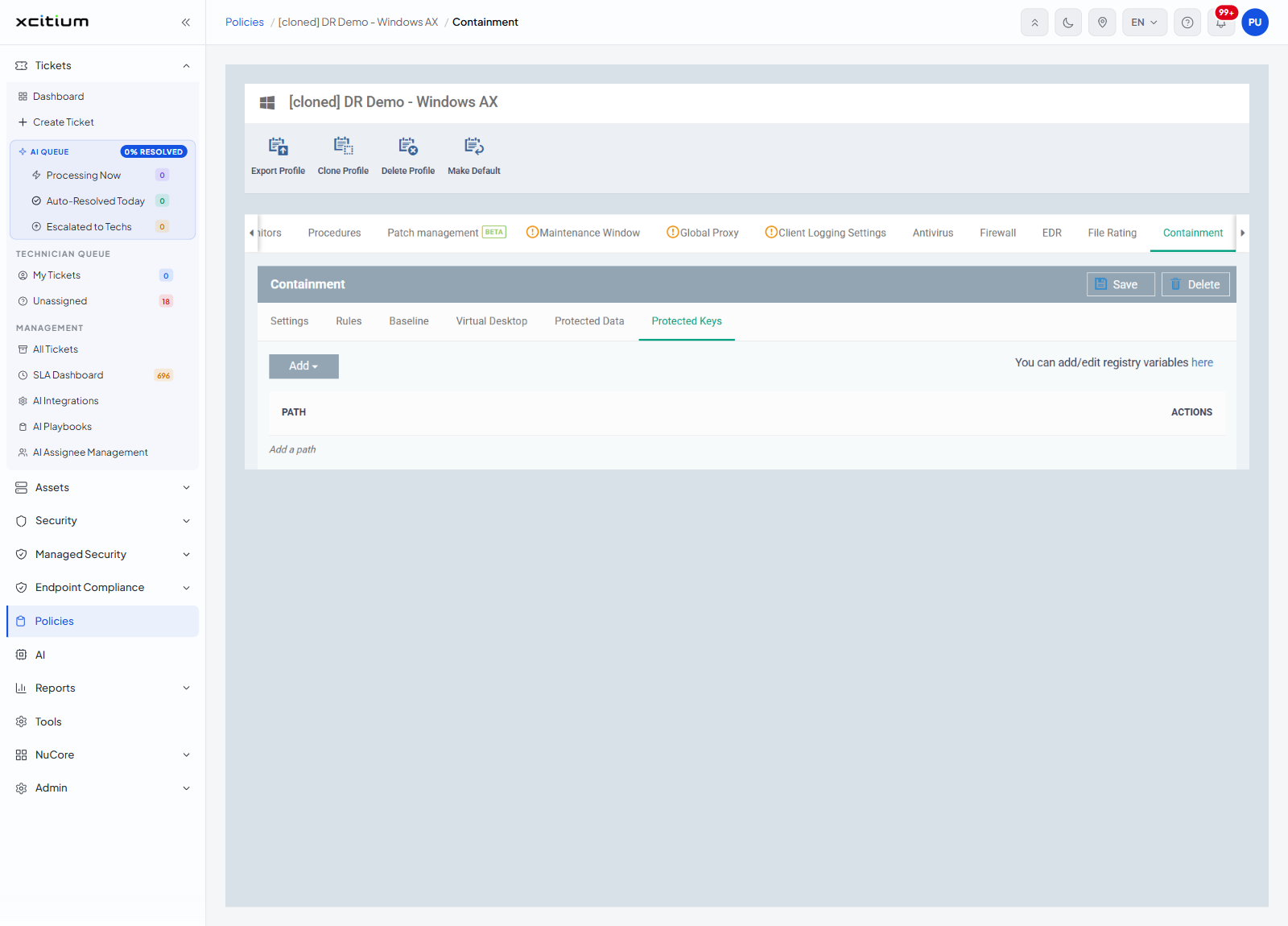
Registry keys that contained programs must not change. An 'Add' drop-down button sits above the list, and the line on the right reads 'You can add/edit registry variables here', with 'here' as a link. The list has the same two columns, 'PATH' and 'ACTIONS', and shows the placeholder 'Add a path' when it is empty.
Set up containment
- Click 'Policies' in the left navigation bar and open the profile.
- Click the 'Containment' tab.
- On 'Settings', turn on 'Enable Auto-Containment' and set the virtualisation exceptions.
- Click 'Rules' and check the order; the first matching rule wins.
- Use 'Baseline' if you want a learning period before containment starts blocking.
- Set the 'Virtual Desktop' options and who may launch it.
- Add anything sensitive to 'Protected Data' and 'Protected Keys'.
- Click 'Save'.
Note: several settings on the 'Settings' sub-tab have their own 'Exclusions' link. Those lists are separate from 'Protected Data' and 'Protected Keys'.