Comodo Help
Find the desired product help
Xcitium MSP

Xcitium MSP

Xcitium MSP Administrator Guide

English

Print Help
Policies > The Profile Editor > Containment
  • Introduction
    • Key Concepts
    • Best Practices
    • Log In To The Console
      • Reset Your Password
    • The Admin Console
    • The Dashboard
  • Tickets
    • Dashboard
    • Create Ticket
    • AI Queue
      • Processing Now
      • Auto-Resolved Today
      • Escalated To Technicians
    • Technician Queue
      • My Tickets
      • Unassigned Tickets
      • Assign A Ticket From The Unassigned Queue
    • Management
      • All Tickets
        • Ticket Detail
          • Edit A Ticket
          • Reply To A Ticket Or Add An Internal Note
          • View The Activity Log
          • Reassign A Ticket
          • Change Ticket Priority
          • Manage Ticket Attachments
          • Resolve, Close And Reopen A Ticket
          • Merge Tickets
          • AI Insights On A Ticket
          • SLA Status On A Ticket
      • SLA Dashboard
      • AI Integrations
      • AI Playbooks
        • Create A Playbook
        • Playbook Approvers
        • Playbook Tools
      • AI Assignee Management
        • Add An Assignee
        • Add A New User
  • Assets
    • All Devices
      • Device List
        • Filter The Device List
        • Group Management
          • Create A Device Group
        • Enroll A Device
          • Set The Enrollment Options
          • Send The Enrollment Link
          • Enrollment Reference Pages
        • Device Details
          • View And Edit The Device Name
          • View Device Summary Information
          • View Network Information
          • View Policies Associated With A Device
            • Review Profile Suggestions
          • View Applications Installed On A Device
          • View The Command Queue
          • View MSI Installation State
          • View And Manage Patches On A Device
          • View A Device's Groups
          • View Device Logs
          • Manage A Device's Policies
          • Run A Procedure On A Device
          • Install And Manage Packages On A Device
          • Reboot Or Shut Down A Device
          • Collect Performance Logs
          • Change A Device's Owner
          • Delete A Device
      • Bulk Installation Package
        • Customize A Bulk Package
        • Download Remote Control
    • Monitor Health
      • Customize The Monitor Health Cards
    • Monitoring And Management
      • Alerts
        • Create An Alert
        • Configure Alert Settings
        • Set Alert Recipients
      • Procedures
        • Manage Procedure Folders
        • Filter The Procedures List
        • Create A Procedure
        • A Procedure's General Tab
        • View And Edit A Procedure's Script
        • A Procedure's Schedule Tab
        • A Procedure's Execution Log
          • View Execution Details Of A Run
        • A Procedure's Parameters Tab
        • Run A Procedure
        • Clone, Export And Delete Procedures
      • Monitors
        • Filter The Monitors List
        • Create A Monitor
        • A Monitor's General Tab
        • A Monitor's Conditions Tab
          • Add A Performance Condition
          • Add A File Size Condition
          • Add A Folder Size Condition
          • Add A Disk Condition
          • Add A Service Condition
          • Add A Process Condition
          • Add An Event Condition
          • Add A TCP Condition
          • Add A Ping Condition
          • Add A Web Page Condition
          • Add A Device Status Condition
          • Add A Custom Script Condition
          • Add A Security Events Condition
          • Add A Security Client Events Condition
          • Add An OS Patches Event Condition
        • A Monitor's Policies Tab
        • A Monitor's Logs Tab
        • Clone, Import, Export And Delete Monitors
      • Maintenance Windows
        • Add A Maintenance Window
        • Maintenance Window Settings
        • View A Maintenance Window
        • Filter The Maintenance Windows List
    • Network Management
      • Discoveries
        • Filter The Discoveries List
        • Create A Discovery
        • A Discovery's General Tab
        • Discovery Auto Enrollment
        • Discovery Notifications
        • Schedule A Discovery
        • Discovery Logs
        • Clone And Delete Discoveries
      • Network Profiles
        • A Network Profile's Tabs
      • Network Devices
        • Filter The Network Devices List
      • Network Monitors
        • A Network Monitor's Tabs
        • A Network Monitor's Conditions Tab
          • Add A Network Uptime Condition
          • Add A Network Performance Condition
          • Add A Network Disk Condition
          • Add A Network Device Status Condition
          • Add An OID Condition
      • Blueprints
        • A Blueprint's Tabs
          • Add A Blueprint Condition
    • Applications
      • Desktop Application Control
        • Filter The Software Inventory
        • An Application's Pages
        • Create A File Group Variable
        • The Windows Application Store
      • Mobile Application Control
      • Patch Management
        • Filter The Patch List
        • A Patch's Info Pages
        • Create A Windows Patch Procedure
        • Third Party Application Patches
    • Endpoint Intelligence
      • The Endpoint Intelligence Dashboard
      • Device Queries
        • The Schema Reference
      • The Query Library
      • Endpoint Intelligence Monitors
        • Create An Endpoint Intelligence Monitor
  • Security
    • Threat Dashboards
      • Endpoint Threat Dashboard
      • Cloud Threat Dashboard
        • Add A Cloud Account
        • Add A Cluster, Registry Or Code Repository
      • Endpoint Compliance Dashboard
        • Choose The Endpoint Compliance Widgets
      • CTEM Dashboard
      • CTEM Metrics
      • Xcitium Verdict Cloud Dashboard
        • Choose The Xcitium Verdict Cloud Widgets
    • Endpoint Security
      • Alerts
        • Alert Search
          • Alert Search Filters
          • The Alert List
          • Alert Detail
            • Alert Detail For An EDR Alert
            • Alert Detail For A MITRE-Mapped Alert
        • Hash View
          • File Details
        • Device View
          • Device Detail
        • Alert Policy
          • Alert Policy Detail
            • The Condition Editor
          • Create An Alert Policy
        • Suppression Rules
          • Add A Suppression Rule
            • Query Builder Help
      • EXDR
        • Event Search
        • Choose Aggregation Fields And Result Columns
        • Hash Search
        • Device Search
        • Android Threat History
        • Event View
        • File View
        • Device View
      • Security Status
        • Antivirus Scan History
      • Blocked Threats
      • Quarantined Threats
      • Contained Threats
        • Contained File Details
      • EDR Events
      • Firewall Events
      • Autorun Alerts
      • File Rating
        • Detected Scripts
        • Obsolete Files
      • File Verdicts
      • Device Control
      • DLP Configuration
        • Create A Discovery Rule
        • Create A Monitoring Rule
      • DLP Events
        • DLP Logs
        • DLP Quarantined Files
      • Vulnerability Management
        • Vulnerable Devices
    • SIEM - X
      • Event Collection Summary
      • Event Query
      • Long Term Analysis
      • Report Generation
      • Token Management
        • Network Settings
        • User Settings
        • Sensor Settings
    • Cloud Security
      • Issues
        • Findings Summary
        • Rule Engine
        • Registry Scan
      • Cloud Assets
      • Clusters
      • Compliance
        • Compliance Detailed View
      • Runtime Protection
        • Runtime Policies
      • Ticket Summary
      • Cloud Alerts
        • Alert Triggers
      • Cloud Reports
      • API Security
        • API Specification
        • API Scan
    • Network Security
    • Email Security
      • Email Protection
    • Threat Labs
  • Managed Security
    • Service
      • Alerts, Incidents And Website Vulnerabilities
      • Customer Health
      • Add A New Customer
      • Import Customers
    • Customer Summary
    • Service Summary
    • Incidents
    • Log Collection Summary
    • Reporting
    • Tickets
      • Create A New Ticket
  • Endpoint Compliance
    • Work With Endpoint Compliance Lists
    • Agents
      • LightWeight Agents
      • Probe Agents
      • Deprecated Agents
      • Download And Install An Agent
    • All Assets
      • All Assets - Table View
      • View Asset Details
      • Asset Inventory Tabs
      • Asset Problems, Solutions And Compliance
    • Other Assets
    • Deprecated Assets
    • Problems
    • Solutions
    • Pending OS Patches
    • Ports
    • Patch Management
    • Application Baseline Results
    • Certificates
    • Vulnerabilities
    • Application Vulnerabilities
    • Vulnerability By OS
    • OS Vulnerabilities
    • Network Scan Findings
    • Compliance Standards
    • Compliance Assessment
    • Compliance Check Master
    • Discovery Settings And Credentials
    • Manage Mapping
    • Jobs
    • Alerts
  • Policies
    • The Profile List
      • Create A Profile
      • Import A Profile
      • Export, Clone And Delete Profiles
      • Filter The Profile List
    • Policy Configuration
      • Create A Policy
      • Import A Policy
      • Export And Delete Policies
    • Default Policies
    • Predefined Policies
    • The Policy Editor
      • Policy General Settings
      • Policy Associated Devices
      • Add And Remove Policy Sections
      • Policy Antivirus Settings (Linux)
      • Policy Sections By Operating System
    • The Profile Editor
      • Sections Configuration
      • Add And Remove Profile Sections
      • Profile Sections On Other Operating Systems
      • General (Windows Profile)
      • Associated Devices (Windows Profile)
      • Profile Health Check
      • Client Updates
      • EXDR Updates
      • Remote Control
      • Client UI Settings
      • Client Rebranding
      • Client Proxy
      • Client Access Control
      • Remote Tools
      • Monitors
      • Procedures
      • Patch Management
      • Maintenance Window
      • Global Proxy
      • Client Logging Settings
      • Antivirus
      • Firewall
      • EDR
      • File Rating
      • Containment
      • VirusScope
      • Xcitium Verdict Cloud
      • Agent Discovering Settings
      • External Devices Control
      • Miscellaneous
      • Script Analysis
      • Data Loss Prevention
      • XCS Access Control
      • XCS Proxy
      • XCS Updates
      • XCS UI Settings
      • XCS Logging Settings
      • Performance
      • Applications
      • Chat
      • Thumbnails
  • AI
    • Manage Your AI Agents
      • AI Agent Card Actions
    • Switch Between AI Agents
    • Account Settings
    • Add A New AI Agent
      • Add An AI Agent From The Marketplace
    • Request A Managed AI
    • Manage An AI Agent
      • Agent Dashboard
      • Agent Design
        • Embed The Agent On Your Website
      • Agent Integrations
      • Playbooks
      • Ticket Management
        • Assignee Management
      • Approvers
      • Channels
      • Chat History
      • Agent Repository
      • Try Agent
      • Chat Agent Dashboard
      • Question And Answer
      • AI Cache
      • Candidates
      • Interview Questions
      • Keyword Search
    • AI Training
      • Manage A Training Repository
    • Captured Contacts
      • Custom Contact Fields
      • Email Notification Settings
    • Integrations
      • Webhook Request
  • Customers
    • Add A Customer
    • Edit A Customer
    • Delete A Customer
  • Reports
    • Standard Reports
      • On-Demand Reports
      • Scheduled Reports
      • Create A New Report
      • Edit A Scheduled Report
    • Custom Reports
      • The Report Catalogue
      • Configure And Generate A Custom Report
      • Generated Reports
        • View Generated Report Details
      • Advanced Reports
        • The Advanced Reports Screen
        • Quick Start: Your First Advanced Report
        • Pick The Data For A Report
        • Filter Rows
        • Count And Group Results
        • Change The Chart Or Table
        • Build A Multi-Step Report
          • Sort And Limit Rows
          • Add A Custom Column
          • Combine Two Tables (Join)
        • Save, Open And Manage Reports
        • Download Results And View The SQL
        • Toolbar And Bottom Bar Reference
        • Troubleshooting And Limits
      • Reports Beta
        • Reports Beta: Scheduled Reports
        • Reports Beta: Create A Report
    • SLA Reports
    • Audit Logs
      • Filter The Audit Log
  • Tools
    • The Tool Card And Its Controls
    • Download And Use A Tool
    • Xcitium Cleaning Essentials
    • Threat Hunter Assessment Tool
    • Auto Discovery And Deployment Tool
    • Xcitium Remote Control
    • ITarian Remote Access
    • Agent Removal Tool
  • NuCore
  • Admin
    • Staff
      • Add A Staff Member
      • Edit A Staff Member
    • Users
      • User List
        • View A User
        • Create A User
        • Import Users
      • User Groups
      • Role Management
        • Role Permissions And Scope
    • Integrations
      • Office 365
      • AWS
      • SentinelOne
      • Windows Defender
      • Microsoft Entra
      • Google Workspace
      • CrowdStrike
      • Azure Active Directory
    • Licenses
      • License Details
      • Bill Forecast
      • License Allocations
    • Account
      • Your Account
      • Remote Access Support
    • Settings
      • Ticketing Settings
      • System Templates
      • Portal Setup
      • Dashboard Settings
      • CTEM
      • Data Protection Templates
      • Android EMM
      • Apple Business Manager
      • Support

Containment


  • Open a Windows profile, then click the 'Containment' tab.

'Containment' runs programs the client does not recognise inside a container, so that they cannot change the real system. The panel carries 'Save' and 'Delete' buttons and has six sub-tabs.
Xcitium_MSP_1.png

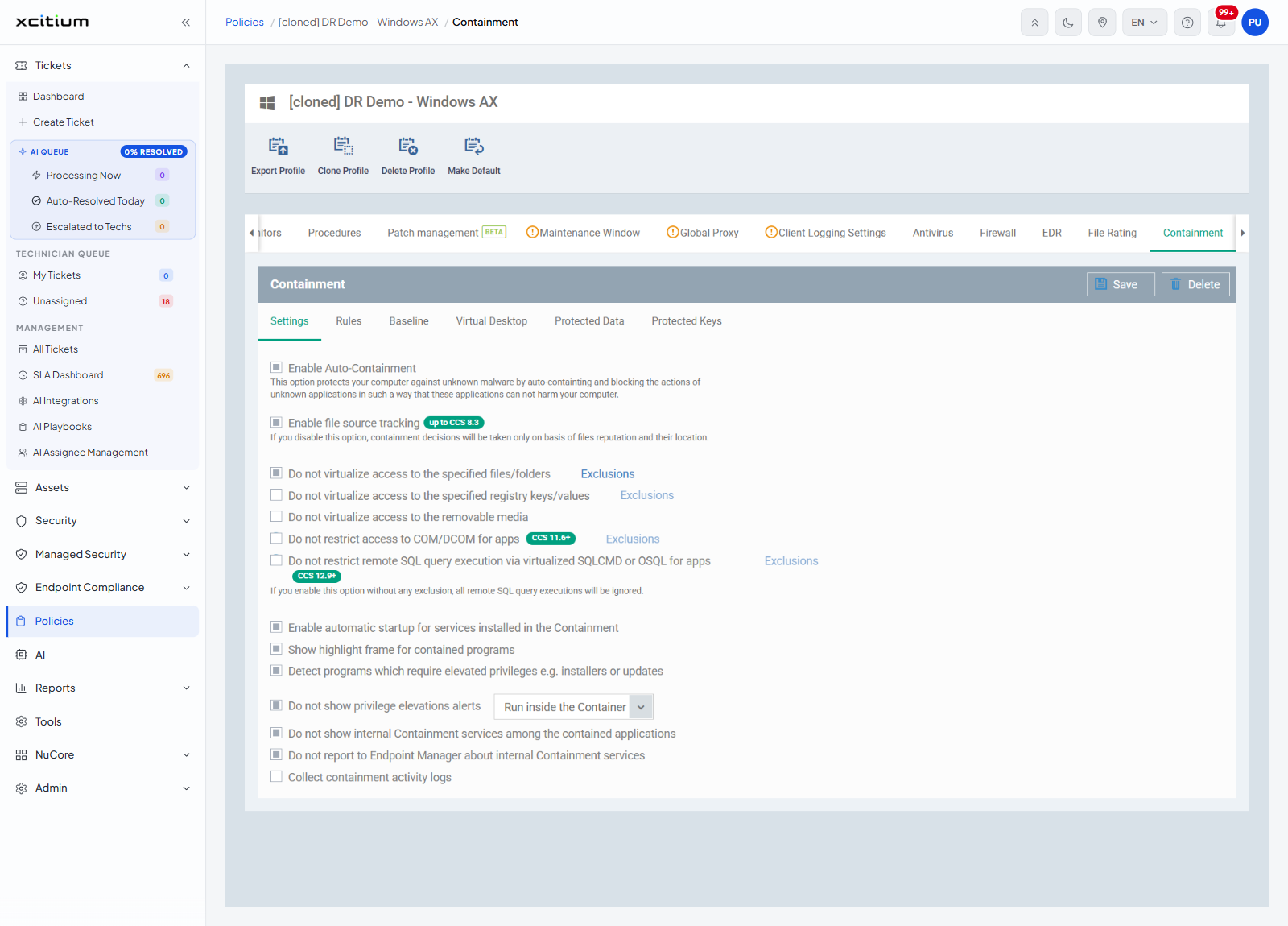
Settings

Setting Badge Description
Enable Auto-Containment — 'This option protects your computer against unknown malware by auto-containting and blocking the actions of unknown applications in such a way that these applications can not harm your computer.'
Enable file source tracking up to CCS 8.3 'If you disable this option, containment decisions will be taken only on basis of files reputation and their location.'
Do not virtualize access to the specified files/folders — Has its own 'Exclusions' link.
Do not virtualize access to the specified registry keys/values — Has its own 'Exclusions' link.
Do not virtualize access to the removable media — —
Do not restrict access to COM/DCOM for apps CCS 11.6+ Has its own 'Exclusions' link.
Do not restrict remote SQL query execution via virtualized SQLCMD or OSQL for apps CCS 12.9+ Has its own 'Exclusions' link. The note underneath reads 'If you enable this option without any exclusion, all remote SQL query executions will be ignored.'
Enable automatic startup for services installed in the Containment — —
Show highlight frame for contained programs — Draws a border round a contained program's window so the device user can see it.
Detect programs which require elevated privileges e.g. installers or updates — —
Do not show privilege elevations alerts — A drop-down underneath sets what happens instead: 'Run inside the Container' (the default), 'Run Unlimited', 'Run Unlimited and Trust' or 'Block'.
Do not show internal Containment services among the contained applications — —
Do not report to Endpoint Manager about internal Containment services — —
Collect containment activity logs — —

Add an exclusion to a setting

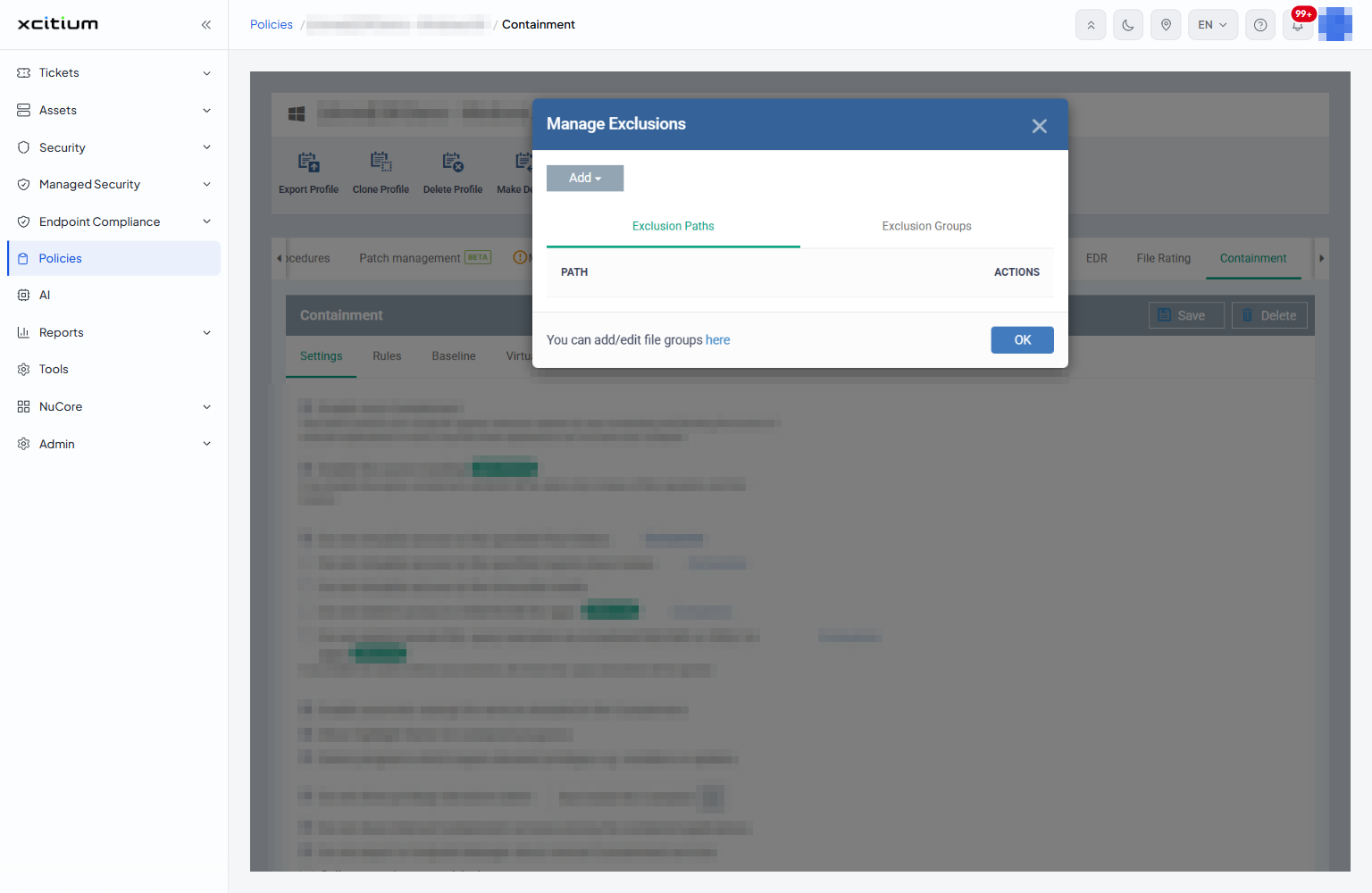
Four of the settings above carry their own 'Exclusions' link: 'Do not virtualize access to the specified files/folders', 'Do not virtualize access to the specified registry keys/values', 'Do not restrict access to COM/DCOM for apps' and 'Do not restrict remote SQL query execution via virtualized SQLCMD or OSQL for apps'. Each link opens the same 'Manage Exclusions' dialog, which keeps a separate list for the setting it was opened from.
Xcitium_MSP_2.png
Control Description
Exclusion Paths A tab listing individual paths, under the columns 'PATH' and 'ACTIONS'.
Exclusion Groups A tab listing whole file groups, under the columns 'Groups' and 'Actions'. The line beside it reads 'You can add/edit file groups here'.
Add A drop-down with two entries. 'Path' adds a single path; 'File Groups' opens a list of the file groups you can add.
  1. Click 'Policies' in the left navigation bar and open the profile.

  2. Click the 'Containment' tab and stay on 'Settings'.

  3. Click the 'Exclusions' link beside the setting you want to narrow.

  4. Click 'Add' and choose 'Path' or 'File Groups'.

  5. Click 'OK', then click 'Save'.

Rules

Xcitium_MSP_3.png

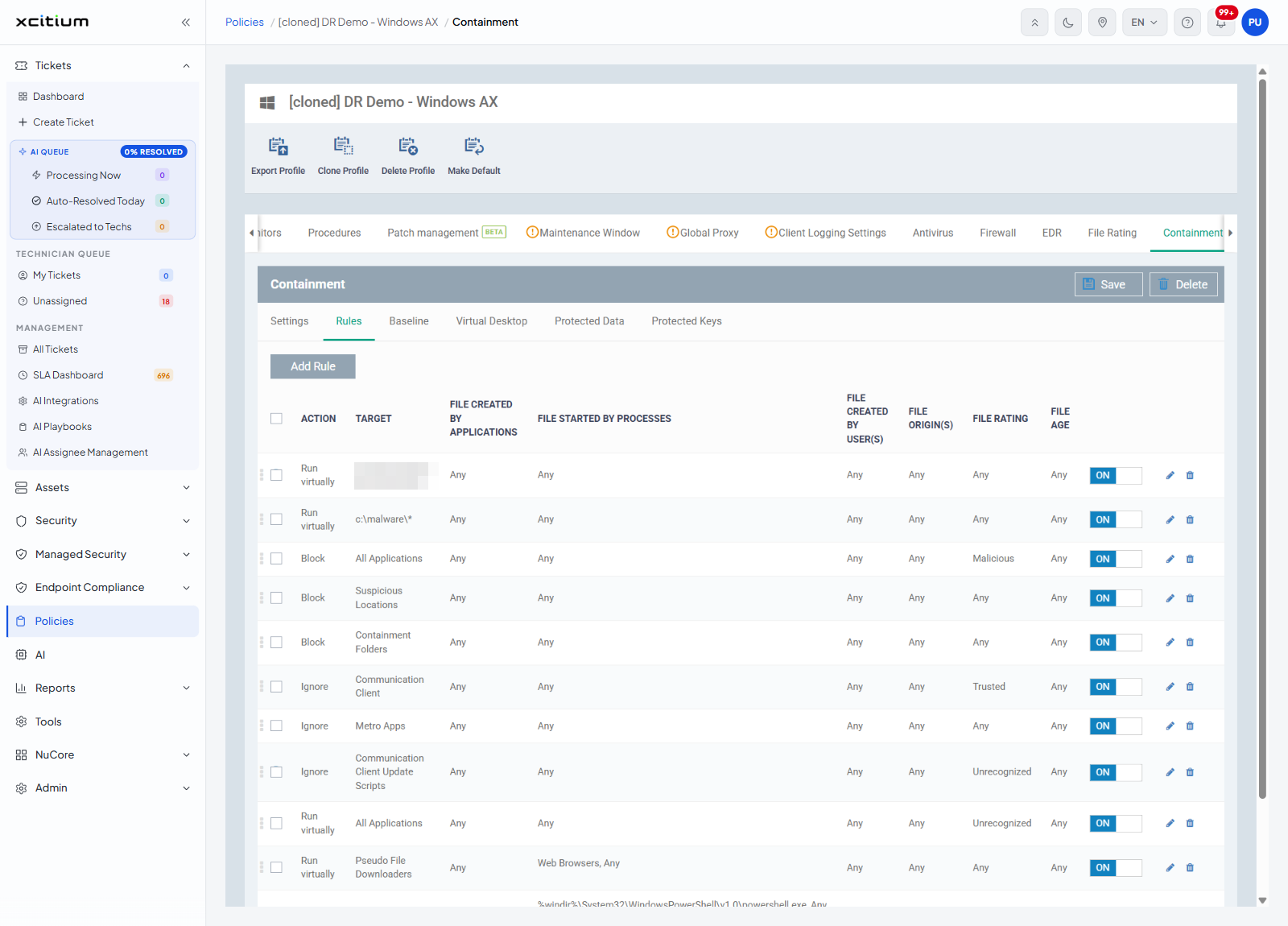
The rules that decide what is contained, with an 'Add Rule' button above the list. Rules are read from the top down.

Column Description
Check box (first column) Ticks the rule.
ACTION What the rule does. The values seen were 'Run virtually', 'Block' and 'Ignore'.
TARGET What the rule applies to — a folder, a file pattern, or a named group such as 'All Applications', 'Suspicious Locations', 'Containment Folders', 'Metro Apps', 'Pseudo File Downloaders' or 'Global Whitelist'.
FILE CREATED BY APPLICATIONS Narrows the rule to files written by named applications. 'Any' when it is not narrowed.
FILE STARTED BY PROCESSES Narrows the rule to files started by named processes, for example web browsers or the PowerShell executables. 'Any' when it is not narrowed.
FILE CREATED BY USER(S) Narrows the rule to files written by named users. 'Any' when it is not narrowed.
FILE ORIGIN(S) Narrows the rule to files from a named origin. 'Any' when it is not narrowed.
FILE RATING Narrows the rule by the file's rating. The values seen were 'Any', 'Malicious', 'Trusted' and 'Unrecognized'.
FILE AGE Narrows the rule by how old the file is. 'Any' when it is not narrowed.
(last column) An ON/OFF toggle that turns the rule on or off.

Add a containment rule

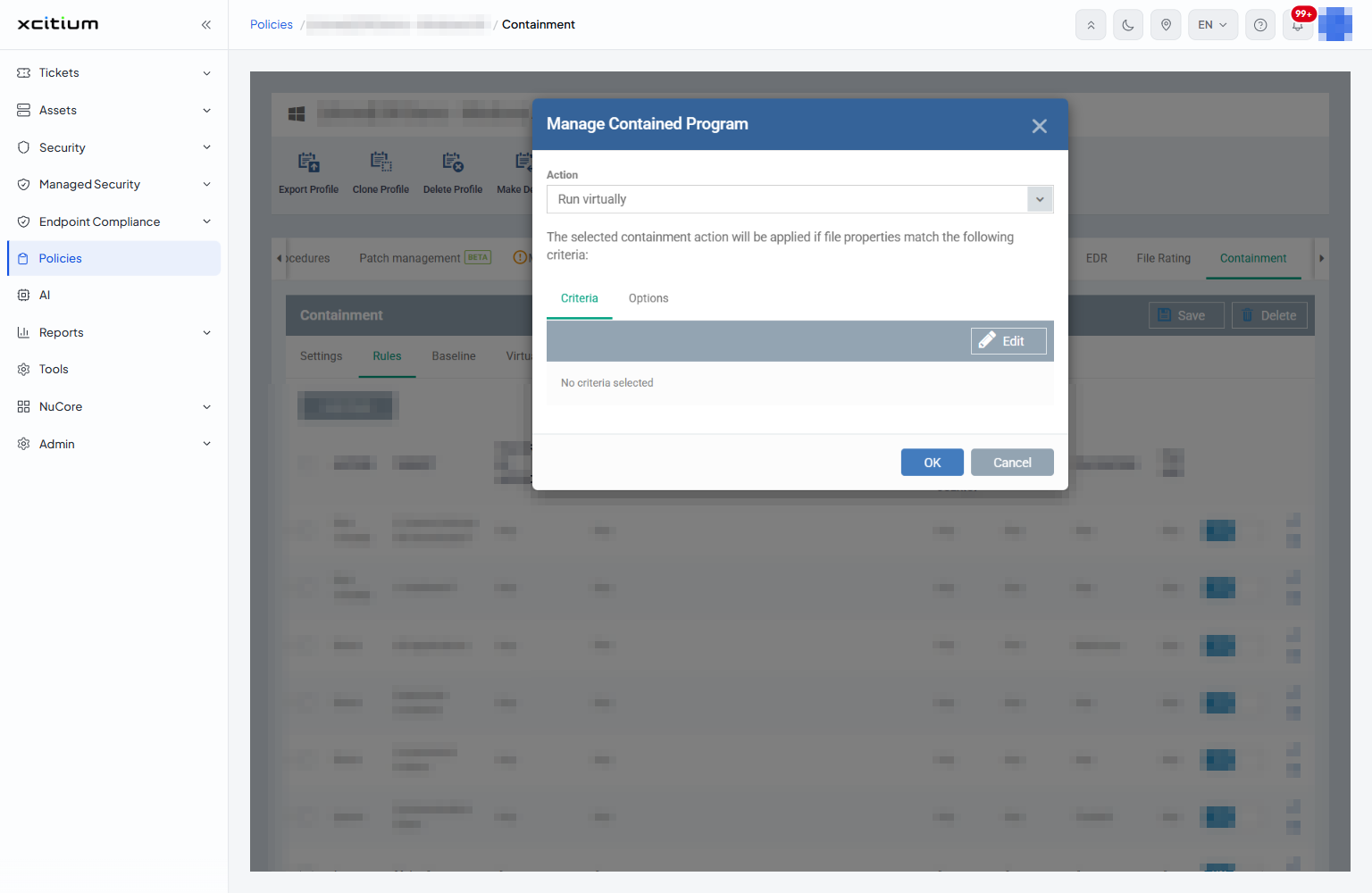
'Add Rule' opens the 'Manage Contained Program' dialog. The line under 'Action' reads 'The selected containment action will be applied if file properties match the following criteria:'.
Xcitium_MSP_4.png
Field Description
Action What the rule does to a matching program: 'Run restricted', 'Run virtually', 'Block' or 'Ignore'.
Criteria A tab holding what the rule matches. It shows 'No criteria selected' until you click 'Edit'.
Options A tab holding the settings below.
Log when this action is performed Records an event each time the rule fires.
Do NOT apply the selected action to child processes Limits the rule to the program itself.
Quarantine program Moves the program to quarantine as well as applying the action.
Set restriction level Sets how much the program may do: 'Untrusted', 'Restricted', 'Limited' or 'Partially Limited'.
Limit maximum memory consumption to (MB) Caps the memory the program may use.
Limit program execution time to (sec) Caps how long the program may run.
Prohibit usage of SMB shared resources Keeps the program off network shares.
Don't allow access to other processes memory Keeps the program out of the memory of other programs.

Choose what a containment rule matches

'Edit' on the 'Criteria' tab opens the 'File Criteria' dialog, headed 'Please select the criteria to be applied'.
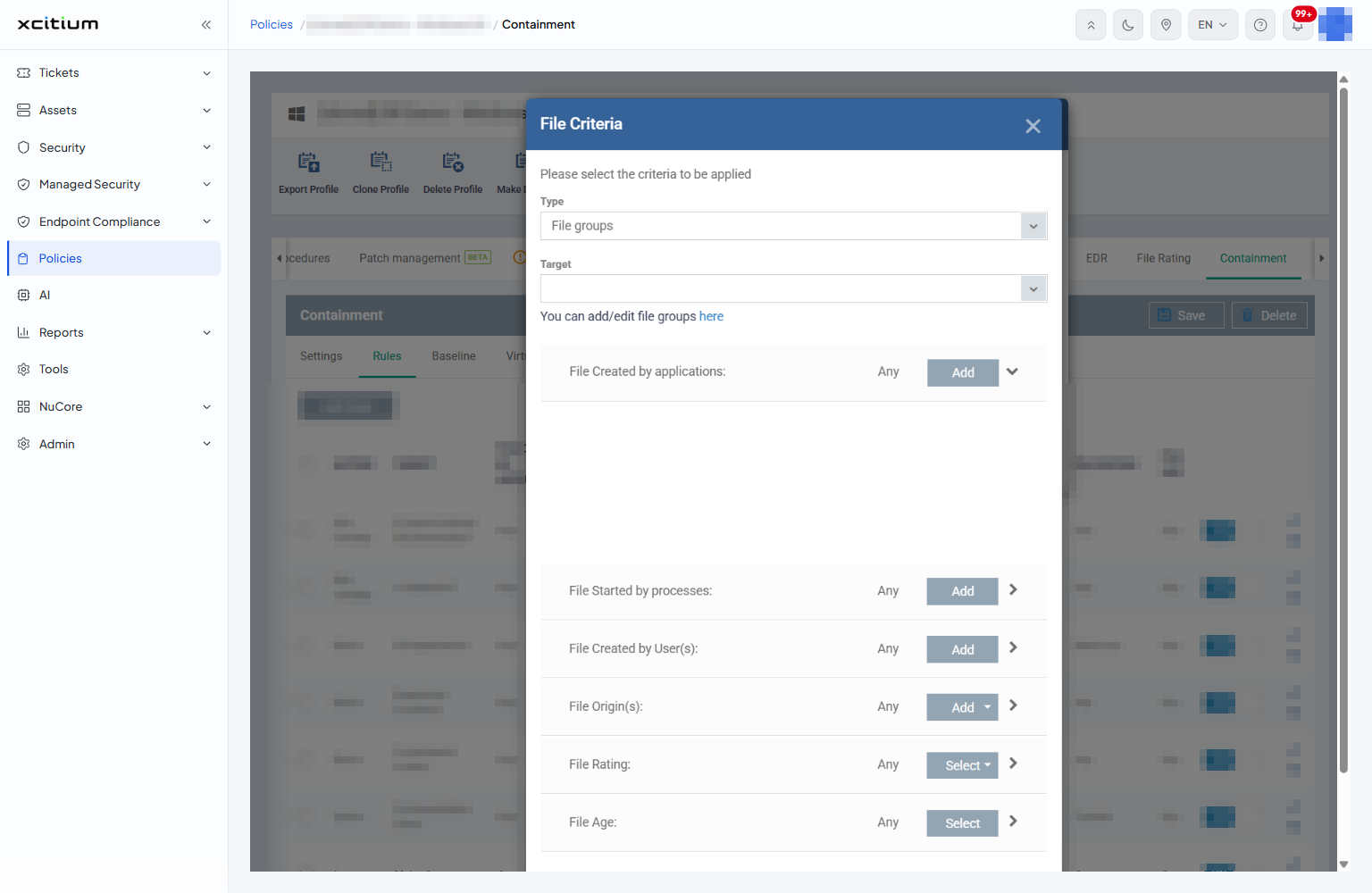
Xcitium_MSP_5.png
Field Description
Type What the rule is matched against: 'Files', 'File groups', 'Folder', 'File hash' or 'Process hash'.
Target The thing of that type the rule covers. The list changes with 'Type'.
File Created by applications: Narrows the rule to files written by named applications. 'Add' picks them. Leave it as 'Any' not to narrow.
File Started by processes: Narrows the rule to files started by named processes.
File Created by User(s): Narrows the rule to files written by named users.
File Origin(s): Narrows the rule by where the file came from: 'Internet', 'Removable Media' or 'Intranet'.
File Rating: Narrows the rule by rating: 'Trusted', 'Unrecognized' or 'Malicious'.
File Age: Narrows the rule by how old the file is.
  1. Click 'Policies' in the left navigation bar and open the profile.

  2. Click the 'Containment' tab, then click 'Rules'.

  3. Click 'Add Rule' and choose the 'Action'.

  4. On 'Criteria', click 'Edit', choose a 'Type' and pick the 'Target'. Narrow it further with the rows underneath if you need to.

  5. Click 'OK' to close 'File Criteria'.

  6. Click 'Options' and set the logging and restriction options.

  7. Click 'OK', then click 'Save'.

Note: a new rule goes to the bottom of the list. Move it up if it must be read before an existing rule.

Baseline
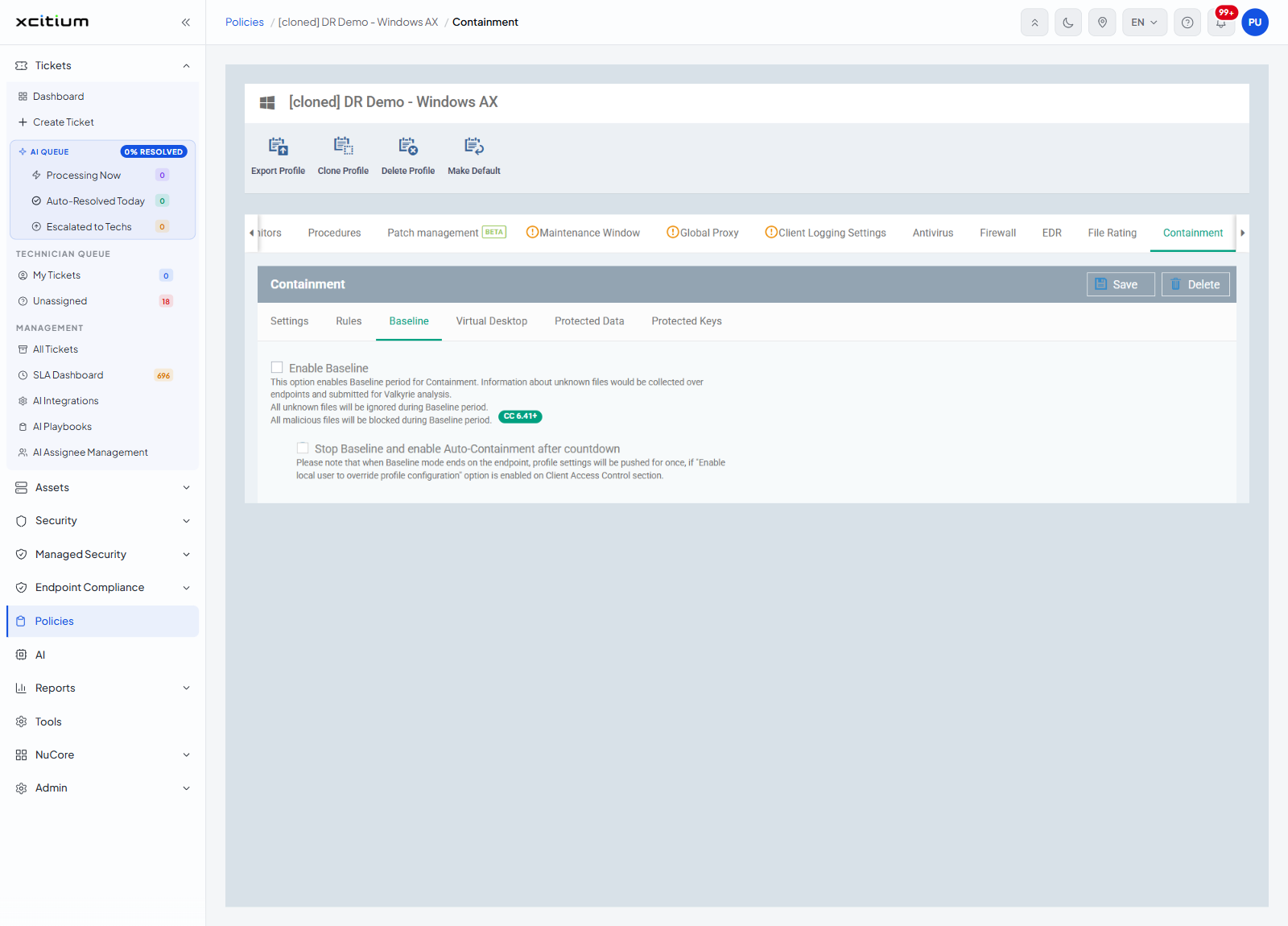
Xcitium_MSP_6.png
Setting Badge Description
Enable Baseline — 'This option enables Baseline period for Containment. Information about unknown files would be collected over endpoints and submitted for Valkyrie analysis.'
All unknown files will be ignored during Baseline period. — —
All malicious files will be blocked during Baseline period. CC 6.41+ —
Stop Baseline and enable Auto-Containment after countdown — Ends the baseline period automatically and switches containment on.

The note at the foot of the sub-tab reads: 'Please note that when Baseline mode ends on the endpoint, profile settings will be pushed for once, if "Enable local user to override profile configuration" option is enabled on Client Access Control section.'

Virtual Desktop
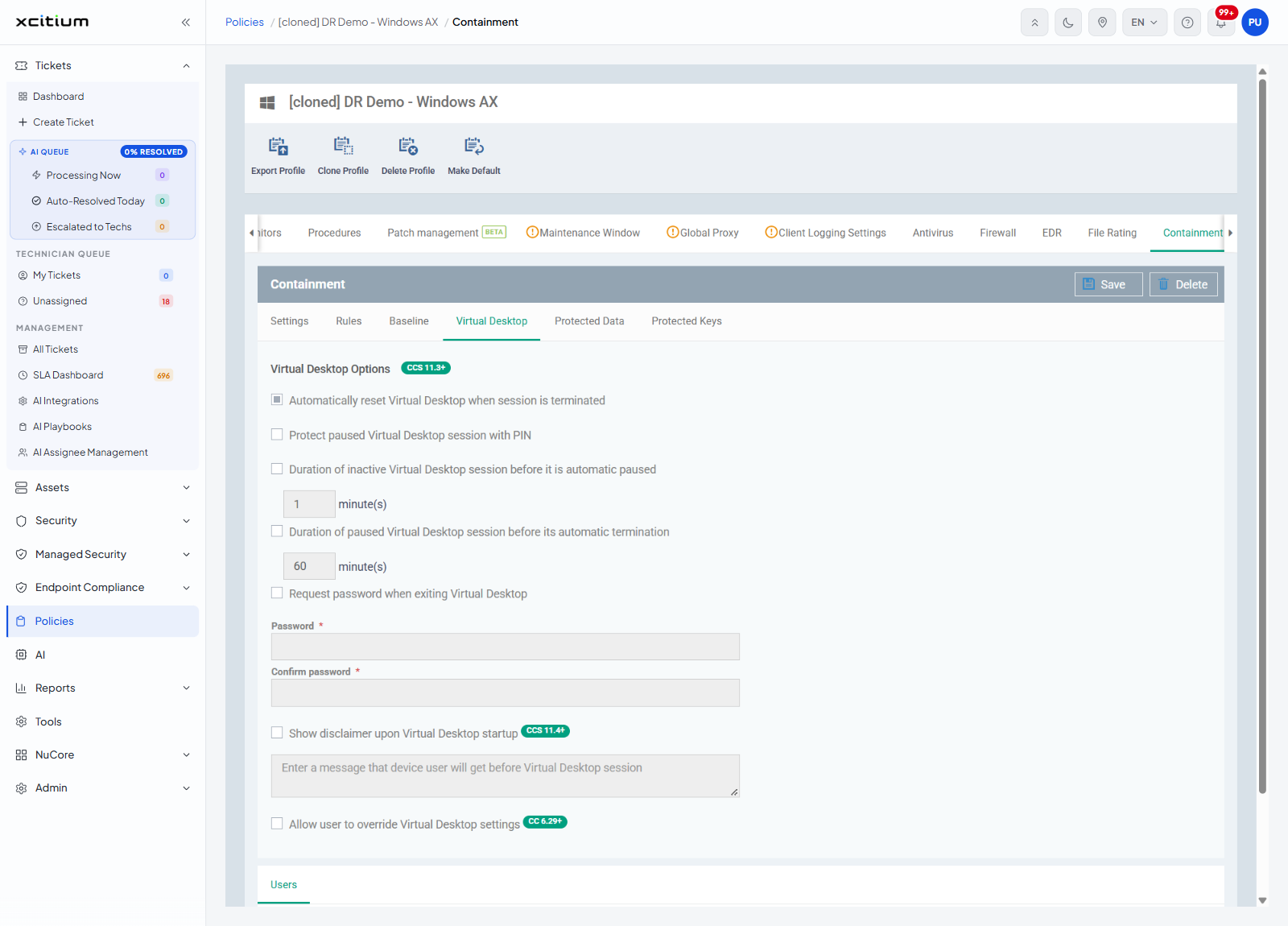
Xcitium_MSP_7.png

The group is headed 'Virtual Desktop Options' and carries the badge 'CCS 11.3+'.

Setting Badge Description
Automatically reset Virtual Desktop when session is terminated — —
Protect paused Virtual Desktop session with PIN — —
Duration of inactive Virtual Desktop session before it is automatic paused — A number box, in minutes.
Duration of paused Virtual Desktop session before its automatic termination — A number box, in minutes.
Request password when exiting Virtual Desktop — Reveals 'Password' and 'Confirm password', both marked with a red asterisk.
Show disclaimer upon Virtual Desktop startup CCS 11.4+ —
Allow user to override Virtual Desktop settings CC 6.29+ —

A 'Users' list at the foot of the sub-tab, with 'Add' and 'Delete' buttons and the columns 'USER/GROUPS' and 'ON/OFF', carries the line 'Add user groups to launch Virtual Desktop upon login'.

Add a user group to the Virtual Desktop

'Add' under the 'Users' list opens the 'Add Creator By' dialog.
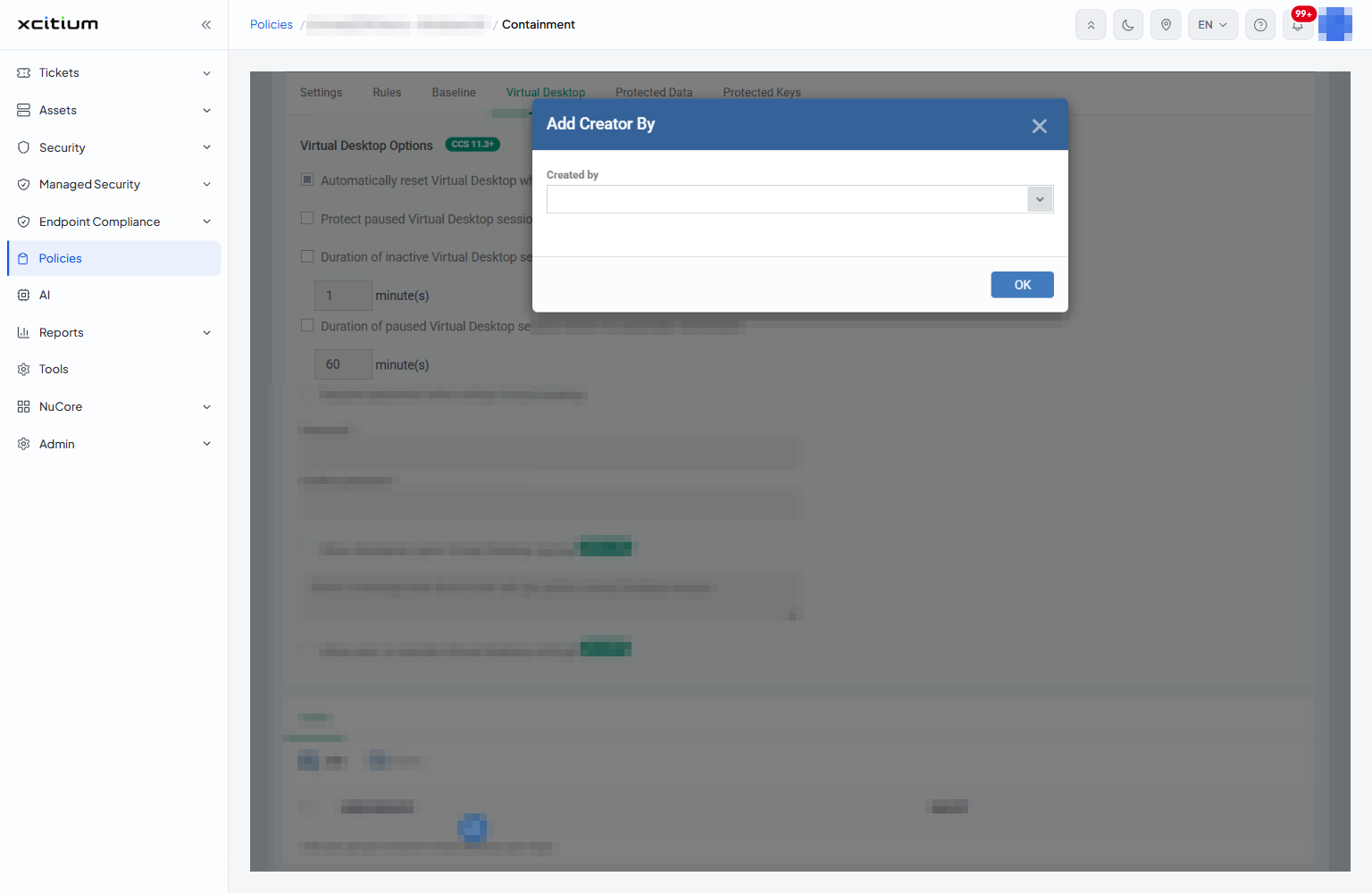
Xcitium_MSP_8.png
Field Description
Created by The user or group that may launch the Virtual Desktop: 'Everyone', 'Local', 'Network', 'Anonymous', 'Authenticated users', 'Administrators', 'Users', 'Guests' or 'Power user'.
  1. Click 'Policies' in the left navigation bar and open the profile.

  2. Click the 'Containment' tab, then click 'Virtual Desktop'.

  3. Scroll to the 'Users' list and click 'Add'.

  4. Choose a group under 'Created by'.

  5. Click 'OK', then click 'Save'.

Protected Data
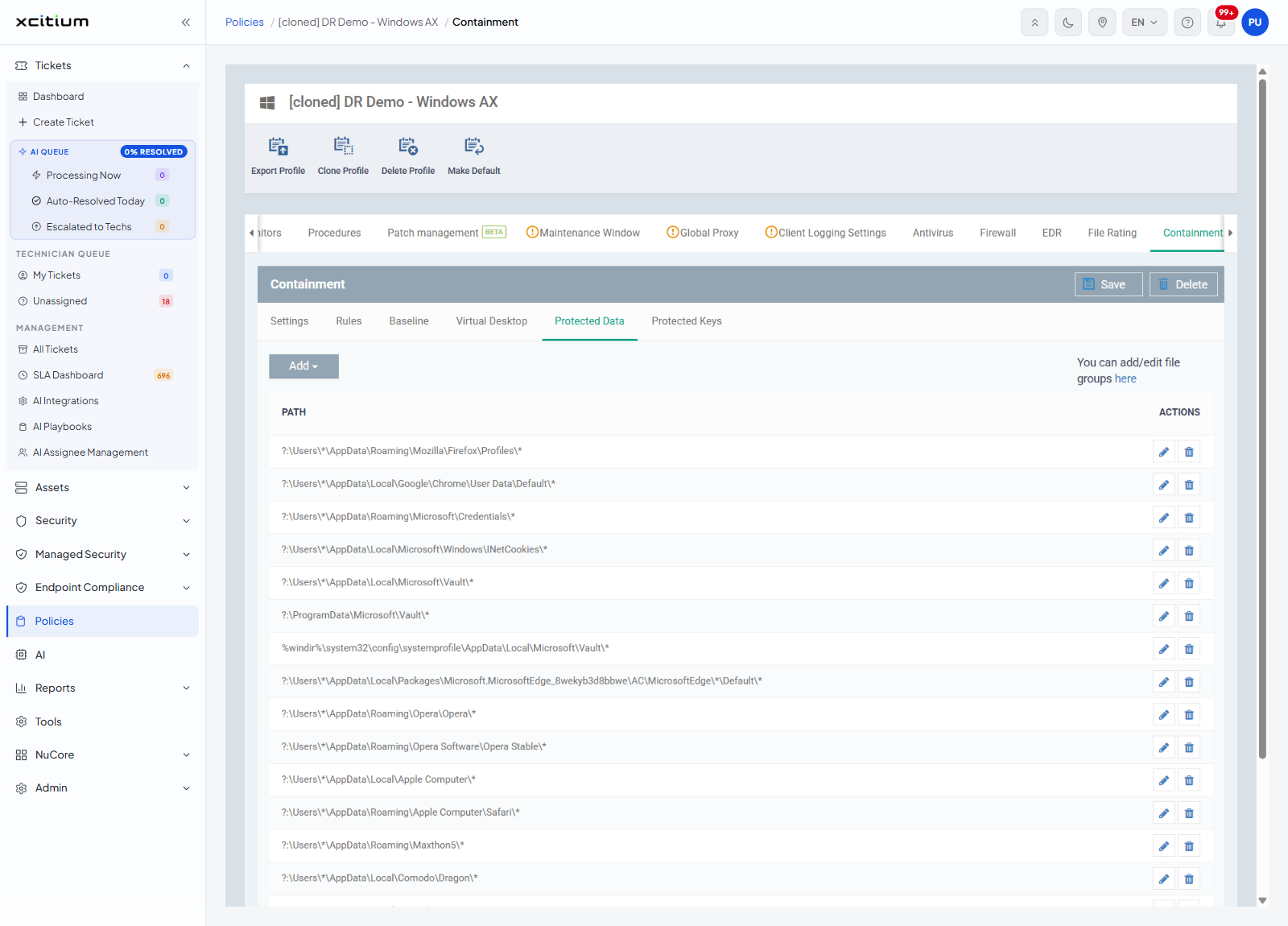
Xcitium_MSP_9.png

Folders that contained programs must not read. The 'Add' button sits above the list, with the line 'You can add/edit file groups here'. The list has two columns, 'PATH' and 'ACTIONS'. The list can include entries such as browser profile folders, credential stores and mail client folders.

Protected Keys
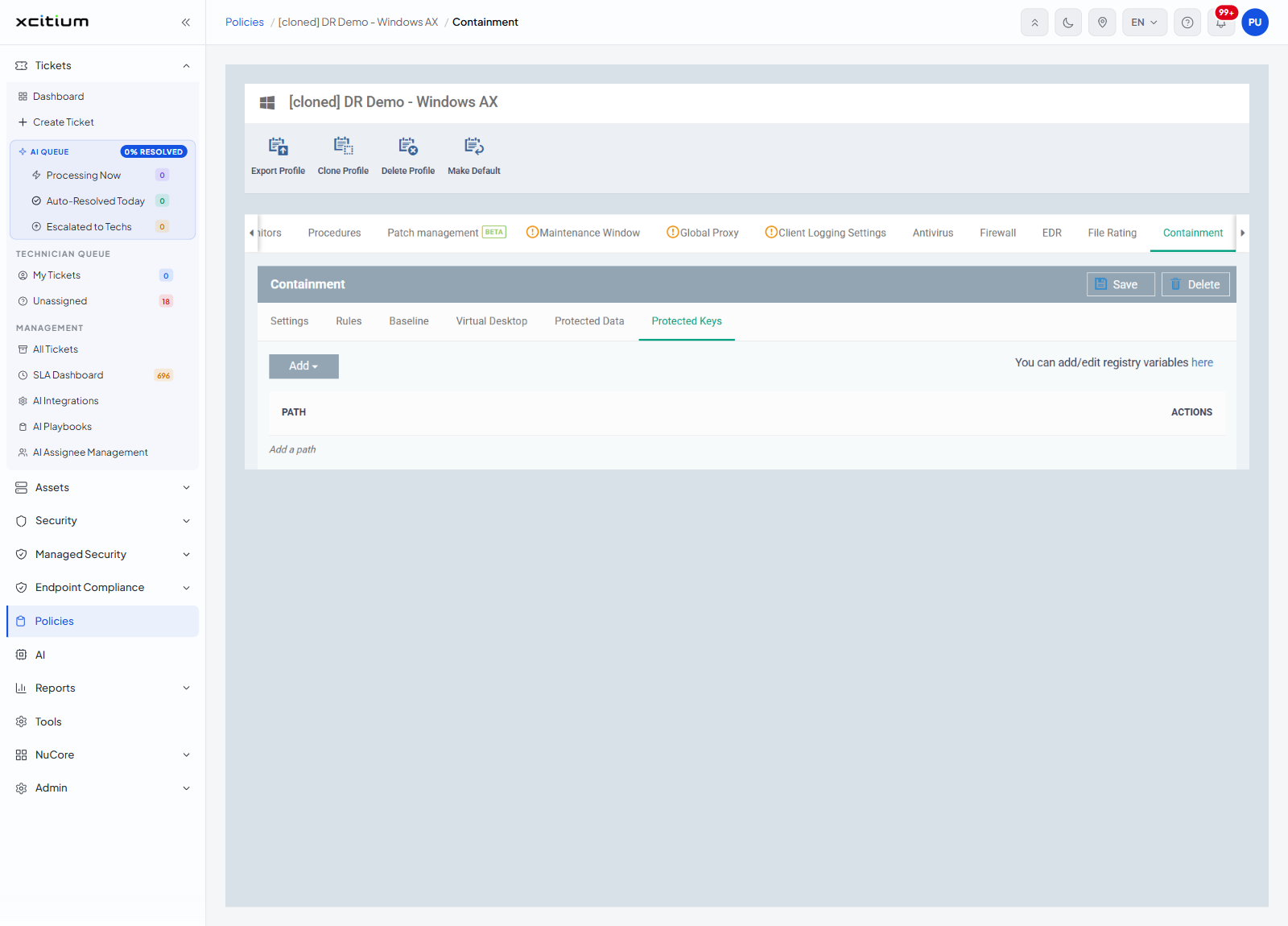
Xcitium_MSP_10.png

Registry keys that contained programs must not change. An 'Add' drop-down button sits above the list, and the line on the right reads 'You can add/edit registry variables here', with 'here' as a link. The list has the same two columns, 'PATH' and 'ACTIONS', and shows the placeholder 'Add a path' when it is empty.

Set up containment

  1. Click 'Policies' in the left navigation bar and open the profile.

  2. Click the 'Containment' tab.

  3. On 'Settings', turn on 'Enable Auto-Containment' and set the virtualisation exceptions.

  4. Click 'Rules' and check the order; the first matching rule wins.

  5. Use 'Baseline' if you want a learning period before containment starts blocking.

  6. Set the 'Virtual Desktop' options and who may launch it.

  7. Add anything sensitive to 'Protected Data' and 'Protected Keys'.

  8. Click 'Save'.

Note: several settings on the 'Settings' sub-tab have their own 'Exclusions' link. Those lists are separate from 'Protected Data' and 'Protected Keys'.


Our Products
  • Free Antivirus
  • Free Internet Security
  • Website Malware Removal
  • Free Anti-Malware
  • Anti-Spam (Free Trial)
  • Windows Antivirus
  • Antivirus for Windows 7
  • Antivirus for Windows 8
  • Antivirus for Windows 10
  • Antivirus for MAC
  • Antivirus for Linux
  • Free Endpoint Security
  • Free ModSecurity
  • Free RMM
  • Free Website Malware Scanner
  • Free Device Manager for Android
  • Free Demo
  • Network Security
  • Endpoint Protection
  • Antivirus for Android
  • Comodo Antivirus
  • Wordpress Security
Cheap CDN
  • Bootstrap CDN
  • Semantic UI CDN
  • Jquery CDN
  • CDN Plans
  • CDN
  • Free CDN
Enterprise
  • Patch Management Software
  • Patch Manager
  • Service Desk
  • Website Down
  • Endpoint Protection Solutions
  • Website Security Check
  • Remote Monitoring and Management
  • Website Security
  • Device Manager
  • ITSM
  • CRM
  • MSP
  • Android Device Manager
  • MDR Services
  • Managed IT Support Services
  • Free EDR
Free SSL Certificate
Support Partners Terms and Conditions Privacy Policy

© Comodo Group, Inc. 2026. All rights reserved.